Wherefrom Comes Happiness?

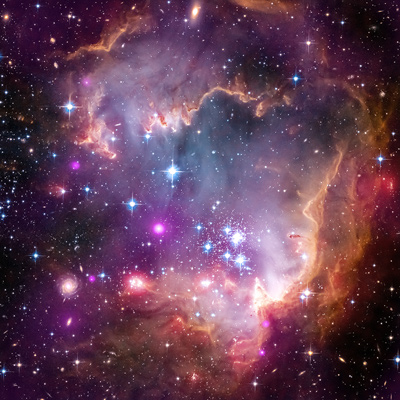
Taken Under the  Wing  of the Small Magellanic Cloud Credit: NASA, ESA, CXC and the University of Potsdam, JPL-Caltech, and STScI

Taken Under the Wing of the Small Magellanic Cloud
Credit: NASA, ESA, CXC and the University of Potsdam, JPL-Caltech, and STScI

In this day and age, we live in a world that focuses on, and values, material things rather than the spiritual qualities of existence. This has led to the widespread rise of the ignoble qualities of personality in many people such as pride, ego, greed, selfishness, narcissism, and self-aggrandizement. Sadly, it appears that a surprising number of people have not known any other way to live.

At the same time, many of these same people are realizing that success in their career, prestige, and the accumulation of worldly possessions do not bring the happiness they assumed would follow. This has been demonstrated to us again and again through people we know and from stories of celebrities we read about or see on TV. We shake our heads and ask why happiness has eluded such privileged people.

What I have come to know in reflecting on my life is that material things did not make me happy. Rather, loving and helping others has brought me the greatest happiness, satisfaction, and fulfillment.

Although worldly possessions will not bring happiness, wanting for things you do not have can make you unhappy. It is the wanting itself that brings discontent, not the lack of things desired.

In my view, we should not be asking God for material things. God gives each of us the gifts and material things that he wishes us to have and that best serve his life plan for us. We should accept these with genuine gratitude and give thanks. Rather than ask for more, we should share what we have with others, especially the less fortunate.

I believe that praying should be reserved for giving thanks for what God has given to us, no matter how meager it may seem, and to ask for help for ourselves or others who are sick, in pain, or who are having difficulty with the trials and tribulations of everyday life. When we focus on others, the “need,” desire, and wanting for material things disappear, and our spirit begins to express itself.

We need to find a way to replace wanting with unselfish giving. It’s not complicated. This truly is the key to happiness and a spiritual way of life.

Spirituality: A Life of Action

There are many attributes with which one can compare people. This is a murky business because things are rarely just black and white. It is more a question of which human attributes are more prominent than others in an individual. When it comes to exhibiting spirituality, it seems there are those who primarily talk and think about it, and others who mainly do things to help others.

Both are important and contribute to our understanding of what it means to be a spiritual person. However, I believe that one’s actions are far more important in defining one’s spirituality than simply talking about it. Spirituality is a way of living rather than a way of thinking or talking.

It may seem odd to say that actions such as going to one’s place of worship regularly, or reading the scriptures may or may not be indicators of a truly spiritual person. Some of you may know people who do these things, but whose behavior otherwise militates against their being spiritual.

I believe that love and compassion for others are the foundation for living a spiritual life, or as I prefer to say, living the life of spirit. But not as a concept; rather, as an expression or outlet for our spirituality. I believe these two attributes to be at the core of our divinity. If someone is unable, for whatever reason, to express these two attributes, then the path to expression of their spirit-self probably has not yet begun.

More likely is that we do not consistently exhibit love and compassion. We may have biases or prejudices through which we filter who is “deserving” of our love and compassion. This is wherein lies the challenge in trying to fully express our spirit. As hard as it may be, we should strive to have love and compassion for everyone.

It might help to remind ourselves that we do not know what demons others face in life. We do not know what experiences have shaped their current state of existence. We do not know the nature of the karma that brought them to where they are.

But whatever these unknowns may be, we need to try our best to give them the benefit of the doubt and extend a helping hand whenever we can, even though sometimes they might slap it away.

It’s Not All About Me

In my quest to become a more spiritual person I sometimes forget that it’s not all about me. It is so easy to get caught up in focusing on my internal spiritual communion when in fact I should be focusing on everything all around me. A life of goodness must be all encompassing.

I must remind myself that while spirituality is found in part through internal reflection, it goes beyond self. It is not just a personal evolution. It is also making a connection with all of creation. It is about truly caring for (all) others, all living things, the planet, and so forth. With that care comes a sense of responsibility for the welfare of all these things.

I realize that I will not be fully developed spiritually until I  can consistently do that. By directing my awareness on people and things outside of myself, I draw forth the divinity inside me that I want so much to express and experience.

As more and more of us direct our awareness and caring outside ourselves, we join together in a spiritual evolution of the human race. I believe this is our true calling. This is our common path to the highest realms of spiritual existence.

What Is Love?

It is easy to get confused concerning which feelings are love and which are not. Perhaps, none more so than the love between a man and women. The problem may come from what we refer to as physical attraction. The attraction may be sexual (e.g., they are good-looking or good in bed), or psychological (e.g., the forbidden fruit, one’s celebrity, wealth or position, or the classic “bad boy” [or girl] attraction). These are all based on physical elements.

Likely, we have all seen high failure rates for relationships that arose from these factors. This suggests that there is a lot of confusion out there concerning the physical versus transcendent aspects of love. The physical motivators for “love” are consistent with the materialistic values that seem to be so widespread today.

It is uncertain to what degree the transcendent quality of love is experienced by lovers today given the high divorce rate. Could true love be an expression of the spirit that transcends the body and all physical modalities? Could true love for another be a spirit(ual) attraction and experience?

There are different contexts in which we love another—that between a parent and child, between friends, romantic love between lovers, and so forth. Societal norms dictate limits on how we can physically express love in these various types of relationships. However, I believe that love is love regardless of the context. That is, I do not believe that transcendent love varies by context, only how it is physically expressed.

I believe that love is a form of spiritual energy that is independent of biology and worldly context. Love as spiritual energy may be heralded by that sense of a mutual connection between people. It is a spiritual connection not a physical one. This is what we look for in a mate and find in our family and best friends. When will we learn to go beyond the physical and start to listen to what our spirit tells us?

To What Doth My Heart Hearken? (Part 2)

I originally wrote what appears below concerning various references we make to the heart before the verse in Part 1 of this topic came to be. I toyed with various titles for the article below trying to summarize in a few words what I was trying to address. Then out of the blue came the title above. This title seemed right, but I sensed that there was so much more in the question that it posed.

Over the next few days, the question haunted me. I kept repeating the question (title) over and over in my mind like I sometimes do when I am trying to remember something or solve a problem. Each time I did so, I felt twinges of emotion that begged for expression and understanding. I found myself searching for an answer to the question that went beyond the sort of worldly aspects of what we call “heart.“

Finally, the constant nagging of this question forced me to sit down at the computer and wait quietly for an answer. Soon, the words started to flow effortlessly and the verse in Part 1 was born.

Here in Part 2, we move from the ethereal plane of thought to more applied, experiential sorts of examples of how our spirit can express itself.

There is a way of speaking with which we are all familiar. It is a reference to the heart that we apply to a variety of actions and emotions. I often wondered precisely what we mean when we say “heart” in these contexts.

Some of the sayings we use are things like:

All goodness flows from the heart.
I love you with all of my heart.
He wears his heart on his sleeve.
That act came from the heart.
That artist paints from the heart.
He/she sings from the heart.
And so on…

I think what is implied in these sayings and situations is that the person has called forth in themselves something beyond the physical body. Inspiration that transcends the body.

I think that by “heart” we intuitively (yet perhaps unwittingly) mean spirit. Although I am likely not the first person to come to this realization, this clarifies for me what was previously a somewhat vague reference.

I believe that love, charitable acts, artistic talents, etc. are expressions of the spirit—of our divine selves. Consequently, these are actions that we find most satisfying and fulfilling.

Perhaps the most common reference to the heart is that it is the source of a person’s love. What is suggested here is that love comes from our spirit. I would go further to say that love is the hallmark of spiritual expression. It is the essence of our divine nature. We are only truly happy when we allow our love to flow, but not just for spouse and family; rather, for all people and all of creation. Listen to your heart’s (your spirit’s) sweet refrain!

To What Doth My Heart Hearken? (Part 1)

To what doth my heart hearken?
This is the question that haunts me in every waking moment.
Though it beats in my chest,
My heart seems somehow abstract and transcendent.
It calls to me with sweet refrain.

And like the Siren my heart’s song draws me in a new direction.
But not to destruction; rather, to new meaning and purpose.
I do not want to resist; the melody is too beautiful.
The notes hit a chord that makes my spirit sing.

I am compelled to seek the Source of this wondrous beauty
That I may come to know it in its fullness.

“What would you have me do?” I ask.
The answer came swiftly and powerfully in a single word
That echoed and resonated in the essence of my being—LOVE!

Copyright 2013 by Blair Atherton

In Part 2 next week, I will tell how this verse came about.

Spirituality as a State of Being

I get the impression that much of the general public does not understand what it means to be spiritual, despite the fact that all things spiritual seem to be in vogue right now. This appears to be the case with a surprising number of people regardless of whether or not they are members of a particular religion.

Those who have drifted away from organized religion often say that they are “spiritual” when asked about their religious affiliation. This is a convenient way to defuse the question and avoid further discussion. However, should they be pressed to explain what they mean, they usually respond with something about being in touch with nature or something similar.

Spirituality does not reside in flowery talk of love, light, or communion with angels and spirit guides. In fact, spirituality is a very serious and deep subject that needs to be understood because it is an integral, critical part of our existence. Not everyone expresses their spirituality and, as a consequence, are unable to live a truly happy and fulfilled life.

I believe that spirituality is a state of being and a way of living. It is an expression of the spirit-self in everyday life. It is the certainty of the presence of our Creator in ourselves and all of creation. It is a recognition of our divine self as a part of our Creator. It is the realization that we are an integral part of God, not a disassociated remnant or emanation from Him. This knowledge brings with it great responsibility.

The fact that we can exist in physical and spirit form at the same time may seem a contradiction. What is not understood by many is that our true existence is one of spirit. The body is like a garment the spirit wears for a short time that will be shed when it is no longer needed. It is a means by which we materialize in the physical world to engage in learning and attend to our life lessons.

But in putting on the garment, many things are hidden from us. We may lose sight of the spirit beneath the clothing. We may lose touch with our divinity hidden behind the shroud of our physicality. Looking in from the outside, we strain to see the bits of light that penetrate the fabric. Oftentimes, all we can see is waves of subdued light and shadows of what is on the other side. Our spirituality lies there beconing us like a distant memory we struggle to recall.

Spirituality is a state of being, knowing, and living. It is expressed and characterized through our actions, not our words. It is an expansion of consciousness that sees beyond the body and the self. It is an awareness that all things are a part of God and deserving of our love and respect.

If we are an integral part of God, then we have the qualities and potential of God for infinite love. This means we are imbued with the qualities of love and compassion for all living things. These are at the core of our divine nature, and spirituality cannot exist without their expression.

Thus, to understand and express our spirituality, we must find a way to express our divine nature in our everyday lives through our actions and how we live our lives.