Romeo and Juliet by Franco Zeffirelli Leonard Whiting & Olivia Hussey Paramount Pictures 1968
#weekendcoffeeshare 3/9/16
If we were having coffee, I would tell you how much I love the theme song from Franco Zeffirelli’s Romeo and Juliet. The beauty of the melody and the story it represents brings back many joyful memories of my own love story.
Whenever I hear it, I stop whatever I am doing and just let the melody wash through me. The song reminds me of the power and passion of young love, but not just any love—that one true love that endures through eternity. Feelings of boundless love and compassion well up inside me and I feel like I’m going to burst. Then sometimes tears come as I think of the anguish the two lovers felt in having suddenly lost a piece of themselves that cannot be replaced—a feeling I know only too well.
[Sorry about the ad that precedes it and messes up the transition from blog to music.]
Note to readers:
The Weekend Coffee Share is a WordPress community activity in which I may choose to participate from time to time. As indicated in the activity title, entries will appear on the weekend. In accord with my first contribution, the topics will diverge from this blog’s usual subject matter and likely be of a more personal nature.
I am writing to ask that through your grace and the efforts of your Holy Spirits that the dark minds of the wicked and selfish be turned toward the light of goodness, love, and compassion. I ask that you give us world leaders and governments that are driven by a strong desire for the happiness, health, and well-being of their people and by a strong desire for a peaceful world.
I realize that transformation is a very slow process and that sometimes it is only through great suffering that change takes place; that sometimes it is only through great injustice that justice can finally be achieved; that sometimes it is only through darkness that the search for light and truth begins.
It appears that you have set into motion circumstances to motivate us to change as individuals and as a civilization. You have pointed the way, but I understand that it is up to each of us to contribute to the creation of a better world for ourselves.
I pray with all my heart that the majority of us will hear your call and respond to adversity, not with anger, aggression, or grasping, but rather with equanimity and a strong desire to help one another get through the trials and tribulations we face, and to find lasting happiness through continuing acts of love and compassion.
I am and forever will be your devoted servant.
You might like to see the following related articles:
Path to Enlightenment Photo credit sathyasaibaba.wordpress.com
In my first article on Buddhism, we examined the Four Immeasurable Minds. These may be best described as highly elevated spiritual states of mind or ways of being. The Noble Eightfold Path discussed here can be thought of as a practical guide for living a noble and virtuous life.
The two are interrelated and interactive. Progress toward one fosters progress in the other. When both are present in an individual, the person is not only truly enlightened, but they serve as a role model for those wishing to achieve the highest levels of spirituality.
Some may worry that the Four Immeasurables may be too much of a paradigm shift to achieve or consistently sustain in a world culture that seems to be diametrically opposed to them. Such a shift in one’s state of mind is indeed challenging, but it is a goal well worth pursuing.
The Noble Eightfold Path gives us practical goals for how we should strive to live our everyday lives in a manner that leads to spiritual awakening and liberation from a mind-set of greed, hatred, violence, duplicity, and self-aggrandizement. It is a path that can transform us spiritually and prepare us for progression to the divine state of the Four Immeasurable Minds.
The Noble Eightfold Path
The word “right” in this context means “in the right and most beneficial or positive way.”
1. Right View or Understanding.
Right view is seeing and understanding things clearly as they truly are. It is also the ability to distinguish between thoughts and actions that are wholesome or unwholesome. Right view requires a flexible, open mind. It leads to an understanding of the law of cause and effect or moral law of karma; namely, that any action will produce results or effects that have the same nature as the action.
2. Right Thinking, Thought, or Intention.
We need to free our minds from bias, prejudice, wrong perceptions, making assumptions, and judging. Through right thought one makes an effort to rid one’s self from what they know to be wrong or immoral. In so doing, we are making a commitment to follow a spiritual path. Right thinking leads to right speech and right action.
3. Right Speech.
Do not lie, bear false witness, use harsh, hateful, or divisive language, gossip, be rude, engage in useless chatter, etc. Always speak truthfully and lovingly in a manner that brings joy, hope, and understanding to others. Our speech should be guided by right view and right thinking.
4. Right Action or Conduct.
Engage in moral, ethical, honorable, and peaceful action. Practice nonviolence and be committed to protecting all life on earth.
5. Right Livelihood.
Choose a profession that is honorable, ethical, and helps and sustains living things rather than one that supports war, killing, disharmony, or harms, cheats, or exploits them. Five types of livelihoods to be avoided are specifically mentioned:
Trade in any kind of weapons.
Any form of trade in human beings.
Breeding and selling of animals for slaughter.
Manufacture or sale of addictive drugs or intoxicating drinks.
Production or trade of any kind of toxic substance or poison designed to harm living things.
6. Right Effort or Diligence. (Paraphrased from Rahula referenced below)
Right diligence is a concerted effort (1) to prevent evil and unwholesome states of mind from arising, (2) to rid one’s self from such thoughts that have already arisen (3) to produce good and wholesome states of mind that have not yet arisen, and (4) to develop and bring to perfection the good and wholesome states of mind already present.
7. Right Mindfulness.
Right mindfulness is being diligently aware of activities of the body, our sensations and feelings, and our thoughts (and their nature). It is being mindful of and living in the present moment free from all thoughts or concern about the past or the future. In mindfulness we refrain from judgement or interpretation of what we are experiencing in the moment. When we are mindful, right thinking, right speech, right action, etc. will be expressed.
8. Right Concentration.
Buddha said that when we have a singleness of mind supported by the other seven factors of the Noble Eightfold Path we have achieved right concentration. It is an essential component of effective meditation.
Right concentration is described as a one-pointed mind. That is, the ability to focus or concentrate on one thing. Right concentration encompasses and is facilitated and supported by the other seven elements of the Noble Path. The practice of right concentration allows us to cultivate insight and develop wisdom by examination of the true nature of things through meditation.
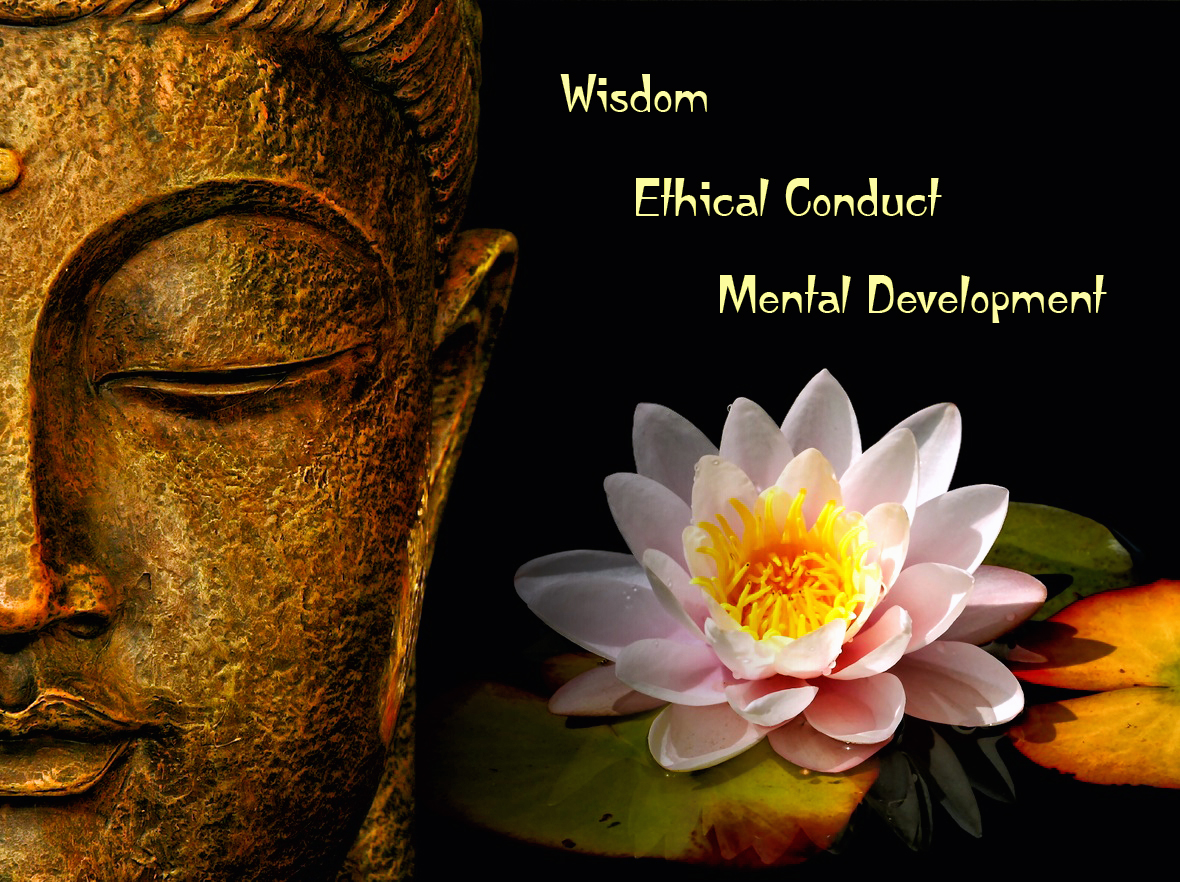
It is by striving to follow the Noble Eightfold Path in our everyday life that we develop the basic principles of ethical conduct, mental discipline, and wisdom which are central to Buddhist practice. Buddha gave many discourses on each element of the Path to explain their meaning in great depth. Consequently, my brief explanations are sorely incomplete and do not give a full appreciation of the scope and quality of each element of the Path.
While many components of the Eightfold Path are things for which most people seeking a spiritual way of life would strive, the Path codifies a stepwise process to achieve them. The Noble Eightfold Path encompasses universal elements of a spiritual way of life. Many of them resonate with the teachings of Christianity and other religions.
I would place persons who engage in spiritual practices and thought akin to those of Buddhists among the exalted meek who are said to one day inherit the earth. In a world seemingly filled with murky shadows and darkness, they are a beacon of light and hope.
References
Hanh, Thich Nhat, The Heart of the Buddha’s Teaching. Transforming Suffering into Peace, Joy, and Liberation. New York: Harmony Books. 2010. First published 1999.
Rahula, Walpola. What the Buddha Taught. 2nd ed. enlarg. New York: Grove Press. 1974. First published 1959.
You might like to see the following related articles:
I have been curious about Buddhism ever since years ago reading Siddhartha, the story of the life of Buddha. As a spiritual practice, Buddhism seemed somewhat mysterious, esoteric, and complex. All this talk about oneness, meditation, and remaining unattached perplexed and confused me. At the same time, there was something about it that was very intriguing.
Now having done some reading about the teachings of Buddhism I would like to share with you what I took away as some of its central teachings that have informed my quest for a deeper and expanded understanding of how to live a spiritual life.
In my view, Buddhism is in many ways spiritual practice in its purest, most highly developed form. I say this in part because it is not a religion. Buddha is not a deity. Buddhism is a spiritual way of living, and of conceiving the world and existence. It does not exclude or renounce a higher being; rather, practice of the concepts of Buddhism can serve as an adjunct or complement to any religion or for the nonreligious. For example, Buddhist belief and practice centers around universal love and compassion for all living things.
Buddhism is a very deep and challenging practice with many elements and layers that takes many years of study to comprehend and master. What I share in this and the next article to follow are but two areas of Buddhist teaching that I found interesting and especially informative to living a spiritual life.
The Four Immeasurable Minds
The Four Immeasurable Minds also are called the Four Divine States of Mind or the Four Perfect Virtues. They are said to be purifying states of mind that can transform the world. This is an area of Buddhist teaching that immediately captured my interest because these four virtues embody what I believe to be key attributes of spirituality. The Immeasurables are:
1. Love
2. Compassion
3. Joy
4. Equanimity
These four states of mind and being are said to be at the core of an enlightened person. They guide and empower everything that an enlightened one does and their interplay and application create conditions for progression to the highest levels of spirituality. To practice these effectively one must go beyond self and extinguish the ego.
These divine virtues are meant to be applied not only locally in everyday life, but also to be radiated in all directions throughout the world in meditation and/or prayer. In doing so, one is in communion with God.
Love or Loving-Kindness
One must live in a way that radiates immeasurable love throughout the world to all living things, unconditionally without attachment or preference for one over another.
Compassion
Similarly, one’s compassion for all living things should be boundless and pervasive without discrimination or favor of one over another. It is a sincere desire that the suffering of all living things will diminish or end.
Joy or Empathetic Joy
This is selfless, measureless joy in the happiness and good fortune of all living things.
Equanimity
Equanimity is a clear, tranquil, unselfish state of mind that is free from discrimination and prejudice and holds no enmity for any living thing. It is this state of mind that fosters, facilitates, and supports love, compassion, and sympathetic joy that are all pervasive.
In a world filled with selfishness, greed, self-aggrandizement, and racial, ethnic, and religious discrimination, the Four Immeasurables represent a major paradigm shift. Nevertheless, instilling in one’s self the Four Immeasurable Minds should be the goal of anyone who wishes to be an authentic spiritual person in communion with God. What a wonderful world it would be if everyone (or at least a majority) patterned their thinking and actions according to these four states of mind!
References
Brahmavihara. Wikipedia.org. Accessed February 6, 2016.
Hanh, Thich Nhat, The Heart of the Buddha’s Teaching. Transforming Suffering into Peace, Joy, and Liberation. New York: Harmony Books. 2010. First published 1999.
As part of my study of other religions and what each has to offer concerning an expanded spirituality, I recently finished reading the Qur’an. There are many books about the Qur’an and some seek to distill it down or interpret it for the reader. I wanted to read the full text myself and form my own impressions about its meaning and significance. The following discussion reflects my personal understanding of the main thrust of the Qur’an through the eyes of a non-Muslim.
I think reading the original and forming one’s own opinions about it is especially important in today’s environment of fear and distrust of Muslims stemming from the horrific actions of so-called Islamic extremists. This is in many ways a misnomer because the actions of these extremists are neither called for nor condoned by the Qur’an. Therefore, their self-described devotion to Islam is belied by their actions.
So what are the main teachings of the Qur’an as seen through the eyes of this non-Muslim? First, it is made clear that the Qur’an was sent to reaffirm the earlier teachings of the Torah and New Testament concerning how to live a spiritual life. The Qur’an places Muslims among the descendents of Abraham and frequently cites stories from the Old Testament about Abraham, Noah, and others to illustrate points of teaching.
I found the Qur’an to be very repetitive with regard to its main messages. In my view, the primary message is that there is only one God who made heaven and earth, who is all-knowing, all powerful, merciful, and has dominion over all things. Other recurring precepts are that there will be a resurrection of souls, and a final Day of Judgement. Those who lived a life of goodness will receive rewards in the hereafter, and those who refused to believe the above will find nothing but torment in the fires of hell. The foregoing doctrines are found in virtually every sura of the Qur’an.
The Qur’an describes itself as good news for the believers, and a strong warning for the disbelievers. It makes it clear that it is not our place to punish the disbelievers; that is God’s right alone. Further, the reference to disbelievers does not refer to non-Muslims; it refers to all who do not believe in the one true God, resurrection, and the Day of Judgement. The Qur’an originated at a time in history when much of the Arabic population followed polytheist beliefs.
From the point of view of a Muslim, what I have derived from the Qur’an may be seen as an over simplification. I hope nothing I have said will be in any way be offensive to anyone. It is just one man’s condensed view of a religion rich in tradition and devotion.
Muslims, Christians, and Jews share common roots and in fact have a spiritual kinship. I think the main teachings of Islam shared by these religions of Abrahamic origin, will always remain salient, timeless, and universal. I do not believe that there is only one true/correct religion; rather, I believe there is only one true God who wishes to guide us all to the path of goodness, virtue, and everlasting life.
Reference
Haleem, M.A.S. Abdel., trans., The Qur’an. Oxford: Oxford University Press, 2010. First published 2004.
You might like to see the following related article:
Do genetically modified food crops present a clear and present danger? New research and common sense suggest the affirmative.
There appears to be much controversy concerning health safety issues surrounding the farming of genetically modified (GM) food crops and its impact on public health. Recent research reviewed below indicates that significant health risks associated with GM crops do in fact exist. In my view, the so-called controversy is actually a public relations campaign especially by Monsanto to deceive the public, legislators, and regulators into thinking that GM crops and the methods to farm them present no health threat.
The chemical industry, which now often includes a biotechnology component, has a long history of misleading the public and regulatory bodies concerning the dangers of their products. There are many cases of cover-ups and misinformation ultimately followed by the banning or very tight regulation of some of their products. For example, DDT, PCBs, and Agent Orange (which contains dioxin and 2,4-D) come to mind.
What is happening concerning the “controversy” surrounding the farming of GM crops has some remarkable parallels with the behavior of the tobacco industry when data began to appear suggesting a link to lung cancer. What happened in the tobacco industry is recounted in an article by Robert N. Proctor, Ph.D. at Stanford University titled “The history of the discovery of the cigarette–lung cancer link: evidentiary traditions, corporate denial, global toll” cited below.
Today it is well known and accepted that lung cancer is caused by smoking tobacco. That this might be the case was first proposed in the late 1800’s. By the end of the 1950’s evidence for a link between cigarette smoking and lung cancer was definitively proven by multiple and diverse sources of evidence, including epidemiology studies, animal research, studies of cell pathology in smokers, and identification of cancer-causing chemicals in cigarette smoke. However, it was not until 1964 that the Surgeon General formally declared that cigarettes cause lung cancer.
Before and after the Surgeon General’s report on smoking, the tobacco industry denied any link between cigarette smoking and lung cancer. The industry developed marketing campaigns to confuse the public and make it appear that the link between tobacco and cancer was still controversial when it was not.
These sorts of tactics are used by the chemical/biotech industry today with regard to the safety of GM crops and the herbicides and pesticides used with them. Monsanto is one of the largest producers of GM crop seeds and herbicides used in farming. The industry relies on the ignorance of the public and puts up smoke screens to confuse those who express safety concerns. Contrary to Monsanto’s propaganda, GM crops do not offer any altruistic redeeming qualities.
As I see it, there are two aspects to issues of health safety surrounding GM food crops: (1.) potential dangers imposed by eating the plants themselves and (2.) dangers arising from the herbicides and pesticides used to farm them. GM crops present their own set of health risks that I discussed in a previous article on this topic.
Monsanto likes to focus the discussion on the safety of the GM crops because it is easy for the public and regulators to accept the notion for example that GM corn or soy are really not noticeably different from the native plants. They both look and taste the same. However, they are not the same because the physiology of the GM plants has been altered through genetic engineering.
I believe that focusing on the plants is a ploy by Monsanto to distract attention from a more ominous, clear and present danger—the massive use of glyphosate, the herbicide in Roundup. Monsanto’s GM crops are called “Roundup Ready” because they were created to be resistant to large amounts of Roundup. This was done with the sole purpose of selling huge amounts of Roundup. Some non-corporate farmers do not realize that Roundup Ready crops are GM crops.
Epidemiology was key in the case of tobacco because prior to widespread smoking of cigarettes, lung cancer was virtually unknown. It was so rare that when a case was found, physicians and medical students would gather to see it because it might be a once in a lifetime opportunity.
The World Health Organization (WHO) recently announced that after review of available research on glyphosate that it is a probable cause of cancer in humans. The research accepted for review by the panel was vetted to assure that the authors had no conflicts of interest with industry and that the research was published in respected, peer-reviewed journals. The report includes glyphosate as well as other herbicides and pesticides.
The WHO announcement can be found here. Sources of the research findings included in the WHO panel’s review, some of which are summarized in the next two paragraphs, are reviewed in the WHO report published in the Lancet Oncology which can be found here and reviewed comprehensively in the WHO monograph found here.
Examining disease incidence in potentially high risk populations such as farm hands and farm workers may have merit. Glyphosate was found in the blood and urine of agricultural workers. Case-controlled studies of occupational exposure to glyphosate in the US, Canada, and Sweden has shown an increased incidence of non-Hodgkin’s lymphoma. This approach has also found increased incidence of prostate cancer among agricultural workers exposed to other pesticides. Convincing evidence was also found that glyphosate can cause cancer in animals.
It is possible, as with tobacco, that a link could exist between some rare form of cancer and pesticides or GM crops. Animal studies in mice and rats found that glyphosate induced increased incidence of several cancers, including a rare renal tubule carcinoma. Others included pancreatic adenoma, haemangiosarcoma, and skin tumors. Glyphosate was also shown to induce DNA and chromosomal damage in mammals and in human and animal cells in vitro. Such damage can trigger cancer.
Huge amounts of Roundup are used in the farming of GM crops. According to the Organic Consumer’s Association there are a number of studies suggesting links between glyphosate and a wide variety of diseases and health problems. The article found here summarizes the findings.
If you are wondering whether pesticides used in the farming of conventional and GM food crops actually get into our bodies when we eat these foods, take a look at the short video below.
This pilot study in Sweden clearly shows that we ingest and absorb pesticides into the blood, which find their way to the urine, when eating non-organic (i.e., conventional and GM crops) foods. These days, at least in the US, that means a lot of GM crops. The study tested for insecticides, fungicides, and herbicides, such as 2,4-D but not glyphosate. I have no doubt that high levels of glyphosate would have also been found in this pilot as in other studies.
Glyphosate and 2,4-D are the most widely used herbicides in the US. Both are toxic and carcinogenic. The discussion of GM crops focuses too much on the crops and not enough on the fact that farming of conventional and especially GMO crops results in the deposition of large amounts of pesticides and herbicides on the crops and into the environment. This leads to higher residues in and on the crops we eat. Organic farming does not use the above mentioned herbicides. Organic foods are a bit more expensive, especially for large families, but what is the health of your family worth?
In my view, reason and caution trump the so-called “controversy” promoted by the chemical and biotech industries, especially Monsanto. It seems to me that it is only common sense that chemicals that poison plants, fungi, insects, mice, and rats are also poisonous to humans. Bear in mind that in order for toxins such as herbicides and widely used neonicotinoid insecticides to work, they are absorbed into the plant’s tissues. This means that they cannot be removed by washing the plant before consumption.
The fact is, we don’t know with any certainty what levels of these poisons will produce health problems in humans. There needs to be more research in this area. Just because a clear link between pesticides used in farming and cancer or other diseases in humans has not been definitively shown yet, does not mean that they are harmless. The results of animal studies clearly say otherwise.
The creation of herbicide-resistant GM crops by Monsanto provided the springboard for its billion dollar sales of Roundup worldwide. If the public rejects GM crops, then sales of Roundup will drop dramatically, along with the threat it poses to human health and the environment.
It is time for governments and regulators to discharge their responsibility to protect the public health and environment. It is also time for the public to relentlessly apply pressure every way they can to get GM foods labeled and to push for a ban or tight restrictions on the use of glyphosate and other herbicides and pesticides shown to cause cancer and other health problems in animals and/or humans. Genetically modified crops do indeed present a clear and present danger.
Proctor, Robert N. (2012). “The history of the discovery of the cigarette–lung cancer link: evidentiary traditions, corporate denial, global toll.” Tob Control 21:87-91. Available online at http://tobaccocontrol.bmj.com/content/21/2/87.full (Accessed November 8, 2015).
WHO Press release: IARC Monographs Volume 112: evaluation of five organophosphate insecticides and herbicides. International Agency for Research on Cancer, World Health Organization. March 20, 2015. Accessed online November 8, 2015, http://www.iarc.fr/en/media-centre/iarcnews/pdf/MonographVolume112.pdf
You might also like to see the following related articles published on this blog site:
I love the golden morning light.
It’s warm glow so beautiful.
And when it touches me
It feels so soft and satisfying,
Like a lover’s caress.
I imagine that the hand of God is touching me.
That I am amidst His presence
And feeling His loving embrace.
As the golden morning turns to the brightness of a sun rising higher,
My spirit rejoices and I am filled with joy!
The gentle warmth of the early hours has set the tenor of my day!
The pursuit of happiness leads far too many people down countless blind alleys and confusing twists and turns. Just when we think we have found the key, it vanishes leaving us once again feeling empty and unfulfilled.
Placing a high value on material things and living a material lifestyle naturally leads one to seek happiness from material things. A common misconception is that if I had a new car, or could buy a house, or had more money, or could find the love of my life, or get my dream job, etc. then I would finally be happy.
But each of us has proven this approach and vision of happiness to be false. For many of us, it is easier to identify worldly things and circumstances that might make us happy, rather than doing the soul-searching needed to understand how personal happiness can be nurtured.
None of these worldly things bring genuine, lasting happiness. One reason for this is that such things are transitory, and subject to changes in circumstances that are out of our control. Each of us is responsible for our own happiness. It cannot be given to us by some thing or someone else.
That said, then how does one find true happiness? What exactly does it mean to be truly happy? I believe that true happiness can only be found within ourselves and exists independent of the world around us. Happiness is a reflection of the state of our spirit-selves. Those who have achieved harmony between spirit, mind, and body have found the key to happiness.
I believe that happiness is a natural result of spiritual fulfillment. Nothing brings a greater sense of fulfillment, satisfaction, and purpose than expression of our spirit through love and compassion, and helping others. Reflecting on this, we all know it is true. Loving and helping others brings jubilation like nothing else can. Therefore, we all know that this is the key to deep and meaningful happiness.
The challenge we all face is keeping the spiritual perspective of happiness always foremost in our minds. We must constantly strive to reorder our lives, values, and priorities to pursue spiritual fulfillment and progression, rather than worldly pleasures, satisfaction, and status.
Deep inside we all know the right path for the pursuit of happiness. How many of us can muster the conviction and determination needed to take and stay on that path?
You might like to see the following related articles:
Whenever I see or hear Pope Francis a big smile comes to my face and I am filled with joy, love, and hope. Previous Popes or other prominent religious leaders that I have seen and heard did not have such an affect on me.
I have no idea why he makes me feel this way and I wonder if others have a similar experience. He seems to have an aura about him projecting love and compassion that fills the hearts of those around him, Catholic or otherwise. He inspires hope and points the way to a better world and a better humanity.
When I see the huge crowds that gather to see him, I am encouraged that we are on the verge of a quantum change in the level, pervasiveness, and expression of genuine spirituality in humankind. I see a hunger by the masses for goodness, compassion, equality, and respect among people around the world.
I hope and pray that when the TV news moves on to another story or the Pope retreats to his quarters that the change and noble aspirations he embodies and inspires will remain in the forefront of people’s minds and compel them to emulate this holy man.
You might also like to see the following related articles:
How would you react to a diagnosis of terminal cancer? How would you choose to spend your last days on earth? Would you have regrets or would you look back on a life well-lived, satisfied that you helped as many people as you could? Would you rush out to do and get as many of the things of which you had been deprived, or would you instead reflect upon all that you had already been privileged to do and possess?
You may have heard that our 39th President Jimmie Carter was diagnosed with melanoma, a very aggressive cancer. If you did not see his press conference announcing the diagnosis, it can be found here.
President Carter said some remarkable things about how he is coping with his diagnosis that provides an example and model concerning how one who has a deep belief in God should react. He was totally at ease, relaxed, and smiling throughout the news conference. There was no discussion of doom and gloom, and no self pity.
He said that he was surprisingly at ease with the diagnosis and that he had had a wonderful life filled with many blessings. He was grateful for all the people he was able to help through the Carter Center and Habitat for Humanity.
He went on to say that he would accept whatever treatments are available but that he is in God’s hands. When asked what he would say to other cancer patients he said, “Hope for the best and accept whatever comes.” He said he was as blessed as much or more than any human being and that he was grateful and hopeful. He said that he is ready for whatever is next—the next great adventure.
Doris Kearns Goodwin a presidential historian said that “What we should remember about Jimmie Carter is that he was a good and decent man. In politics today we don’t often get good and decent men running for politics.”
President Carter provides an example of the kind of life we should all strive to emulate: a life of unwavering faith in God, honesty, acceptance of life’s trials, compassion and service to others, and gratitude for the many blessings we receive. May we all do our best to be good and decent human beings.
Information about the work of the Carter Center can be found here.







 Exploring Spirituality Beyond Religion
You must be logged in to post a comment.